Harness Architecture
issue 02 / first spread
The homepage gives a verdict before it sells a concept.
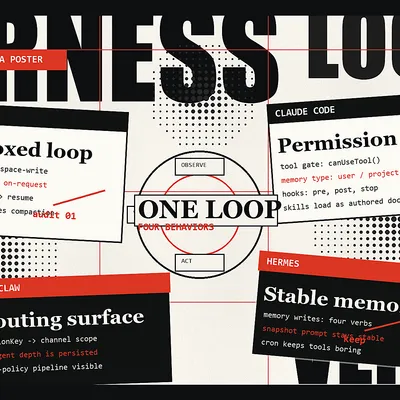
This landing page is arranged like an editorial desk: the oversized title carries recognition, the image reads like a marked-up proof wall, and the index below turns 22 chapters into reviewable engineering questions.
white paper / black type / one red interrupt
dark mode keeps the editorial grid, swapping paper and ink instead of inverting screenshots.
contents / no generic best practices
Enter the architecture like a magazine contents page.
- 0100
Start with the overview
Decide whether your agent should stay light, go heavy, or borrow one layer.
- 0200
Dissect the runtime loop
Observe, plan, act, and verify are recovery boundaries, not just a diagram.
- 0300
Compare the four systems
Put each decision through Codex, Claude Code, OpenClaw, and Hermes.
- 0400
Package the companion skill
The reading ends as operating memory you can load before the next implementation.
reference systems / collisions
The four systems behave like evidence pinned into the layout.
colophon / companion skill
The last page is an operating index, not a CTA.
build-your-own-agent compresses the 22 chapters into 10 rules, an 8-dimension decision table, a Python scaffold, diagnostic scripts, and safety checks. It is an editorial manual you can load before the next build.